We let our alleluias rise on Easter Day. But, to borrow a question I asked here a number of years ago, “Did we overdo Holy Week and Easter Day?”
The problem may not be so much that we overdo Holy Week, the Triduum, and the liturgies of Easter Day. We are right to bring our best to those services and to celebrate them in their fullness.

I have had this deep uneasiness with how we celebrate Eastertide for many years now, and it’s not going away. If anything, it’s getting worse. How are we to reconcile the hard liturgical work of Holy Week with a rich Paschaltide celebration that continues from the celebration of Easter Day itself?
The answer doesn’t seem to be obvious, but I still think it’s worth stirring up a conversation about it.
It is counterintuitive that we haven’t cracked creative celebrations of Easter. We have done well to enrich Advent, Christmas, and Epiphany with all kinds of “lessons and carols” type services.
But even King’s College, Cambridge, that significant locus of 20th-century liturgical innovation for Christmas, has come up empty for Easter. The televised “Easter from King’s” service, which was a Easter counterpart to its beloved televised Christmas service, has been been abandoned, having last aired in 2023.
And while this is disappointing, it’s not entirely surprising. The King’s model of lessons and carols seems to work well for Christmas, but it never really spoke as coherently at Easter. And it is notable that that service took as its starting point not the Resurrection, but the Passion. Perhaps this is the problem in a nutshell: we easily gravitate toward the darkness of the Passion, especially as a contrast with the light of the Resurrection. But how is it that the Church draws out of itself a rich devotional life surrounding the Easter reality?
There have to be new ways to do this in the church. Don’t there?
“We should be taking steps to celebrate Easter in creative new ways: in art, literature, children’s games, poetry, music, dance, festivals, bells, special concerts, anything that comes to mind. This is our greatest festival. Take Christmas away, and in biblical terms you lose two chapters at the front of Matthew and Luke, nothing else. Take Easter away, and you don’t have a New Testament; you don’t have a Christianity… This is our greatest day. We should put the flags out.”
N. T. Wright
Maybe the “special liturgy” model is the wrong one, and as N. T. Wright suggests, we need to be relying on other artistic modalities.
But I still wonder if there are threads of Anglican patrimony that have not been widely encountered at Easter.
Great Paschal Vespers is a short, stational monastic service that has been disseminated in the Episcopal Church through The Prayer Book Office compiled by Howard Galley in 1980. (Read it here or here.) This service may not be a natural fit in every place, but I for one am eager to see it more widely used and its form adapted in different ways.
Stations of the Resurrection (also known as the Via Lucis, or the Way of Light) is an Eastertide counterpart to Stations of the Cross. It is now included in Common Worship , the official liturgical resource in the Church of England. For parishes that offer one or more Stations of the Cross services before Easter, would it not be wise to provide this service at least once in Eastertide?
And let’s not limit ourselves to thought about “extra” devotional services either. Surely the faithful can be brought more deeply into the Easter season with the right touches in the principal liturgy as well.
I have been struck recently by how the simple placement of the paschal candle in the center of the choir can redefine the season visually. In too many places, the paschal candle is nearly invisible, even when lit. A small flame at the top of a candle that remains unlit most of the year doesn’t nearly make impression we think it does. It’s easy to move the Paschal candle to a more prominent location. So let's do it! If it's a bit “in the way,” that's even better! The asperges, a traditional part of the liturgy in this season, can be used as an opening of the Eucharistic rite to great effect.
Stations of the Resurrection, mentioned above, naturally leads us to a consideration of Ascension Day. It is a significant imbalance in our liturgical life that Ash Wednesday enjoys greater observance among the faithful than Ascension Day does. Both are mid-week liturgies. If people can come out on a Wednesday for ashes, surely they can come out on a Thursday for a principal feast of the church. Is Ascension Day not more fun than Ash Wednesday? Can it really be impossible to convince Episcopalians of this?
The answer, at the moment, perhaps is yes. And this problem deserves some reflection too. Have we developed into liturgical introverts who enjoy the darkness of death, but are too afraid to enter into the light and see what it illuminates?
The hymn “Lift your voice rejoicing, Mary” speaks to all of us with its refrain: “Let your alleluias rise.” I hear this now as a charge to the Church to give the Easter season greater richness and devotional texture. The Episcopal/Anglican Church has done this successfully for Advent, Christmas, and Epiphany. But if Easter truly is our greatest day and season and very reason for existence, we owe it to ourselves to find new ways to celebrate the risen Christ in Easter.
Labels: Easter, Great Paschal Vespers, King's College (Cambridge), Lessons and Carols, Stations of the Resurrection
Over on the All Things Rite and Musical podcast (hey, remember that thing?) I've recorded a 10-minute preview of the music for this year's Festival of Nine Lessons and Carols from King's College, Cambridge.
Spoiler alert: the service starts starts with "Once in royal David's city".
It's an audio-only product for now, but I'll probably write a bit more about the service here in the next little while.
(I really did not intend to take a full-year sabbatical from All Things Rite, but that's what happened! Sorry, Ian!)
Labels: Christmas, King's College (Cambridge), Lessons and Carols
A Festival of Nine Lessons and Carols has been held annually at King’s since 1918.
The audio-only broadcast has become a tradition in its own right. The first Festival from King’s was broadcast in 1928. And the tradition of broadcast has continued every year since, even, famously, “during the Second World War, when the ancient glass (and also all heat) had been removed from the Chapel and the name of King’s could not be broadcast for security reasons.”
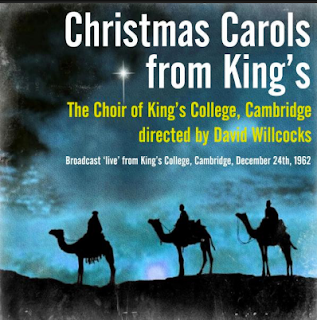
Most video clips that turn up are excerpted from a separate televised service called “Carols from King’s.” This made-for-TV service is pre-recorded and broadcast on BBC television. For non-BBC audiences, it is available as a digital download directly from King’s.
2018 marked the 100th anniversary of the Festival of Nine Lessons and Carols, and it was the final Festival under the direction of Stephen Cleobury. He had held the post of director of music since 1982. His successor, Daniel Hyde, directed his first service in 2019. The service was held, though without a congregation, in 2020. This year is the second time the service will be sung during the ongoing Covid-19 pandemic, and there are plans to admit a congregation.
The service remains deeply loved by many, myself included. And in doing some reflecting on why it is that so many want to return to this service year after year, I encountered this wonderful passage at the end of the first story in A. A. Milne's Winnie the Pooh (1926):
“I do remember,” [Christopher Robin] said, “only Pooh doesn’t very well, so that’s why he likes having it told to him again. Because then it’s a real story and not just a remembering.”
The service begins, as always, with the hymn “Once in royal David’s city.” The descant is by David Willcocks, a former director of music at King’s
After the Bidding Prayer, we hear a carol arrangement that debuted last year: “In dulci jubilo,” arranged by Pearsall, and the director of music Daniel Hyde. This carol tune is heard every year because it is the first Organ Voluntary played at the conclusion of the service. When sung by the Choir, it is most often sung after the Second Lesson. It was last sung after the Bidding Prayer in 2001.
After the First Lesson, we hear a single carol: “The truth from above” by Ralph Vaughan Williams, arranged by Christopher Robinson.
After the Second Lesson, we hear another single carol: “The Holly and the Ivy” arranged by June Nixon. This arrangement was last sung at the service in 2010
It is interesting that Hyde’s pattern of music at the beginning of the service continues to evolve. In what is perhaps an effort to get the service off the ground, the long-standing custom of having two pieces of music after every lesson has been altered after the first two lessons. As a result, in other years where we might have heard four pieces of music after these first two lessons, we hear only two this year.
After the Third Lesson we hear the Sussex Carol in a very familiar arrangement by Willcocks. This Willcocks carol has been sung many times at this service, most recently in 2015. In Daniel Hyde’s first two services as director of music, he has chosen the Vaughan Williams arrangement.
Then follows the hymn “O Little town of Bethlehem.” As always, this hymn is sung to the English tune Forest Green. It was last sung at the 2017 Festival of Nine Lessons and Carols
Following the Fourth Lesson, we hear “In the stillness” by Sally Beamish. Beamish links to a recording of “In the stillness” by the St. Peter’s Singers of Leeds on her website.
UPDATE: King’s has just shared a video of them singing this carol
Though this will be Sally Beamish’s first appearance at the Christmas Eve service, her music is no stranger to King’s College. Her setting of Psalm 46 “Be Still” was commissioned by Stephen Cleobury, and sung at King’s in 2015.
Beamish’s carol is followed by “Gabriel’s Message,” arranged by Willcocks. This arrangement was last sung in 2015.
Following the Fifth Lesson the Choir sings “Make ye merry for him that is come” by Imogen Holst, a carol for SSATB choir published in the 1965 collection Carols for Today from Oxford University Press.
Afterward, the Choir sings Cecilia McDowall’s “There is no rose.” Since 1983, King’s College has commissioned a new carol for the Festival of Nine Lessons and Carols, though no new commission was sung in 2020. McDowall’s “There is no rose” is the commissioned carol this year, and it receives its first performance at this service.
Oxford University Press has summarized the piece this way:
Employing the richness of her distinctive harmonic palette, McDowall pairs upper and lower voices to great effect throughout, contrasting polyphonic writing with moments of rhythmic unison. The carol abounds in rise and fall of both melody and dynamic, before drawing to a hushed, atmospheric close.
After the Sixth Lesson, we hear “Angels from the realms of glory,” arranged by Reginald Jacques, a familiar carol that was last sung two years ago, in 2019.
This is followed by the Wexford Carol, arranged by John Rutter. If, like me, you need the first line of the carol to remember how it goes, the Wexford Carol is the one that begins “Good people all this Christmastide.” It’s an enduring Irish carol, but it has never been sung at this service to the best of my knowledge.
Another Rutter arrangement is heard after the Seventh Lesson: it’s his take on “Silent night.” Rutter has become somewhat synonymous with the Christmas season; he is a prolific writer of original carols and carol arrangements, and his work is prevalent across choirs of all types. Since 2005, a carol by Rutter has been sung at the Festival of Nine Lessons and Carols more or less every other year. 2015 was the last time two Rutter carols were sung within the same service.
Rutter’s “Silent night” is followed by the hymn “While shepherds watched their flocks by night,” arranged, as it was in last year’s service, by Nicholas Marston.
The ordering of the pieces after the Seventh Lesson is another place where we can see a new director of music at work. After switching the order of these two pieces in his first two years as director of music, Daniel Hyde has swapped the order once again. He has restored the pattern that Philip Ledger settled on during his tenure as director of music, and this pattern has been followed in most services ever since. In most years the carol has come first, and then the hymn.
After the Eighth Lesson, the Choir sings “Thou who wast rich.” This is another existing carol arrangement—this time by Charles Herbert Kitson—that has received some further arranging by Daniel Hyde.
After this, the Choir sings Simon Preston’s arrangement of “I saw three ships,” last sung in 2018.
And so we arrive at that climactic Ninth Lesson with its spine-tingling introduction: “St. John unfolds the great mystery of the incarnation.”
It is followed by the requisite hymn, “O come, all ye faithful.” Daniel Hyde’s custom has been to sing all the verses, and he presents a smorgasbord of spectacular arrangements for the final stanzas (Willcocks, Christopher Robinson, and David Hill).
After the Collect and Blessing, all present sing the final hymn: “Hark! the herald angels sing,” with the Willcocks descant.
Of the two Organ voluntaries following the service, the first is always In dulci jubilo, by J. S. Bach, BWV 729. Over the years, the second voluntary presents organists like myself a list of big, festive pieces that have enough “Christmas spirit” to be played at a service like this. This year, we revisit a work last played twenty years ago, the Carillon-Sortie by Henri Mulet
The service, which is broadcast live from England at 3:00 p.m. on Christmas Eve, may be heard on many public radio stations in the United States and is available to stream live on the BBC website at 10:00 a.m. Eastern. As for myself, I’ll be listening at 9:00 a.m. Central. You can also stream the service on demand from the BBC for a month following Christmas Eve.
Oh, and of course, the spreadsheet has been updated: King’s College Festival of Nine Lessons and Carols(1997–2021)
Labels: Christmas, King's College (Cambridge), Lessons and Carols
On the First Sunday after Christmas, we sang a service of Lessons and Carols with Holy Eucharist at the parish where I serve as organist and director of music.
I'm not breaking new ground here. Drop me a line (comment below) and let me know what lessons are used at your service. I'd love to know more about what the church is up to here.
I want to share some thoughts on this with you today for several reasons.
- On the 100th anniversary of Lessons and Carols at King's College, Cambridge, it seems worth recovering something of the spirit of the "more imaginative" worship of which Eric Milner-White was a proponent. I think too often, parishes echo the King's service a bit too closely, and the effect is one of pale imitation, rather than an authentic liturgical expression.
- In some places, there is a desire to do this service, but the thinking tends to be black or white: "we must do all nine lessons or not do the service at all!" This is wrong.
- In other places, the solution seems to be: "let's just do the whole thing before Christmas Eve!" And the service takes place on the Third or Fourth Sunday of Advent. This may be musically satisfying, but it is liturgical suspect.
- The propers for the First Sunday after Christmas can be integrated into this liturgy quite easily.
- With judicious selection of readings (we chose six), Holy Eucharist can be celebrated.
- Using Lessons and Carols during the Christmas Season helps to heighten the parish's sense of Christmastide celebration. Clergy like to point out that Christmas lasts for twelve days. If it does, we should find ways to make it festive.
- Many choirs learn a great deal of music for Christmas Eve. Why not get a bit more use out of it?
- There is no situation where this order could not be adapted for the musical resources available.
I hope this will be useful to many Episcopal (and other churches) that may wish to imitate what we have done.
Some background: St. Peter's, St. Louis, the parish where I work, had a long custom of Morning Prayer, but has in recent years moved to a near-weekly celebration of the Holy Eucharist at the principal liturgy. When we conducted this service on Sunday morning three years ago, we were able to use the full nine lessons in a "Morning Prayer" mode. But, with the addition of Holy Eucharist, this was untenable.
Can I just pause here to say how much I admire (and envy) the custom of Christmas Lessons and Carols at Church of the Advent, Boston on New Year's Eve?
St. Peter's has full choral Lessons and Carols services for Advent and Epiphany, so this Christmas service is not as important as it may be in some places. It seemed good to us to be slightly experimental with this liturgy in that it does attempt to fully reconcile a service of Lessons and Carols with a celebration of the Holy Eucharist, and the result – I think – was very successful.
Here's a play-by-play of the service, which was preceded by the Prelude on "Irby" by David Willcocks (found in the Oxford Book of Christmas Organ Music).
- Processional Hymn: "Once in royal David's city"
I do think it's good to begin this service with this hymn, though I have been known to use a different hymn. And I think it's good to have at least two stanzas sung from the choir where possible.
I had toyed with the idea of the full soprano section singing the first verse in unison, but without the aid of a conductor, this proved unwise. There's nothing wrong with a solo voice, it seems!
To add a bit of originality, I wrote my own descant for this tune.
The textual differences between the Hymnal 1982 and the version found in Carols for Choirs 2 are maddening. Pick one and stick with it. (Note to self: take this advice next year.) When in doubt have the congregation sing one version and the choir another (haha! This is a joke!).
- Bidding Prayer
Here is where "local interests" may appear, but seldom do. We added in the full name of our Diocese and made a couple other minor changes to eliminate gendered language.
It is important to omit the Lord's Prayer from the Bidding, as it will be prayed during the service of Holy Communion.
Beloved in Christ, be it this Christmastide our care and delight to prepare ourselves to hear again the message of the angels; in heart and mind to go even unto Bethlehem and see this thing which is come to pass, and the Babe lying in a manger.
Let us read and mark in Holy Scripture the tale of the loving purposes of God from the first days of our disobedience unto the glorious Redemption brought us by this Holy Child; and let us make St. Peter’s Church glad with our carols of praise: But first let us pray for the needs of his whole world; for peace and goodwill over all the earth; for unity and
brotherhoodconcord within the Church he came to build, and especially in this Diocese of Missouri.And because this of all things would rejoice his heart, let us at this time remember in his name the poor and the helpless, the cold, the hungry and the oppressed; the sick in body and in mind and them that mourn; the lonely and the unloved; the aged and the little children; all who know not the Lord Jesus, or who love him not, or who by sin have grieved his heart of love.
Lastly let us remember before God all those who rejoice with us, but upon another shore and in a greater light, that multitude which no
manone can number, whose hope was in the Word made flesh, and with whom, in this Lord Jesus, we for evermore are one.The Almighty God bless us with his grace; Christ give us the joys of everlasting life; and to the fellowship of the citizens above may the King of Angels bring us all. Amen.
- Invitatory Carol
This Invitatory Carol after the Bidding Prayer should be considered optional, I think. I had planned on one initially. But in the late stages of putting the service together, I decided to cut it.
I'll note the full specifics of the music we used below.
I referred to this as our "just add water" Lessons and Carols, since it was mainly music we had sung on Christmas Eve.
But obviously the choice of music can make the service anywhere from exceedingly simple to ridiculously complex. A very satisfying order could be made of all hymns from the Hymnal 1982. One or two pieces should be sung after every lesson (one of which could be a hymn).
- First Lesson: Genesis 3: 8-15, 17-19
This is the First Lesson in the King's service.
In our service, these Lessons are read very much as they are every Sunday. They were from the NRSV, as they are every Sunday of the year. They were introduced with "A lesson from..." and concluded with "The Word of the Lord / Thanks be to God."
- Carol/Hymn
- Second Lesson: Isaiah 61:10-62:3
This Lesson is the Old Testament Lesson for the First Sunday after Christmas in the Revised Common Lectionary. (It is the same set of lessons in all years, A, B and C!)
- Carol/Hymn
- Third Lesson: Luke 1: 26-35, 38
This is the Fifth Lesson at King's.
- Carol/Hymn
- Fourth Lesson: Luke 2: 1, 3-7
This is the Sixth Lesson at King's.
- Carol/Hymn
- Fifth Lesson: Luke 2: 8-16
This is the Seventh Lesson at King's. We felt especially justified not including the Eighth Lesson since we get a hefty dose of it next Sunday when we celebrate the Feast of the Epiphany. (Our feelings on this might change when we don't celebrate Epiphany on Sunday.)
- Carol/Hymn
- Sixth Lesson: John 1: 1-18
Not only is this the Ninth Lesson at King's, but it is also the Gospel Lesson for the First Sunday after Christmas. (Note that this lection is four verses longer than King's.)
We had a Gospel procession during the hymn preceeding, and read this Gospel in the usual way for a service of Holy Eucharist. (Note: there is no sermon or creed.)
- Hymn 87: "Hark! the herald angels sing"
- I've included this hymn by name, since I think whatever is sung after the final lesson needs to be "big," as it is at King's. There's no need to throw "O come, all ye faithful" into this service necessarily (we used "Angels from the realms of glory" as the final hymn, and the roof lifted slightly), but I don't think you can go wrong singing Mendelssohn after the prologue to John's Gospel.
- Salutation and Collect of the Day
In this case, the Collect for the First Sunday after Christmas.
- The Peace
After which, the service procceds like a standard Holy Eucharist.
Final thoughts: we did not incorporate the Epistle Lesson for the First Sunday after Christmas. This is a very short lesson, and this would be easy to do. It does not seem desireable, however, to incorporate the proper Psalm in a service of this type.
I'm also aware that this activity flies in the face of the perscription NOT to replace the Word of God with a service of Lessons and Carols in the Book of Occasional Services. I think that guidance is, well, misguided.
As promised, here are the full details for the Service of Lessons and Carols and Holy Eucharist sung on the First Sunday after Christmas at St. Peter's, St. Louis.
- Processional Hymn: "Once in royal David's city"
- Bidding Prayer
- First Lesson: Genesis 3: 8-15, 17-19
- Carol: Adam lay ybounden - Boris Ord
- Second Lesson: Isaiah 61:10-62:3
- Hymn 89: "It came upon the midnight clear"
- Third Lesson: Luke 1: 26-35, 38
- Carol: The Cherry Tree Carol - arr. Stephen Cleobury
- Fourth Lesson: Luke 2: 1, 3-7
- Anthem: "Love came down at Christmas" - Leo Sowerby
- Fifth Lesson: Luke 2: 8-16
- Hymn 101: "Away in a manger"
- Sixth Lesson: John 1: 1-14
- Hymn 87: "Hark! the herald angels sing"
- Collect of the Day
- The Peace
- Offertory Anthem: "A Wonder of Angels" - Sasha Johnson Manning (St. Peter's commission)
- Eucharistic Prayer, Sanctus, etc.
- Communion Carol: Sans Day Carol - arr. John Rutter
- Communion Hymn 104: "A stable lamp is lighted"
- Postcommunion Prayer
- Blessing
- Hymn 93: "Angels from the realms of glory"
- Dismissal
- Organ Voluntary: In dulci jubilo, BWV 729 - J. S. Bach
Labels: Communion, Lessons and Carols, St. Peter's (St. Louis)
Sinden.org has published its annual preview of the music list for the 2017 Festival of Nine Lessons and Carols from King's College, Cambridge.
You may interested to view a spreadsheet of carols sung at this service from 1997 to the present, as well as some information about services prior to 1991. That can be accessed at Sinden.org/carols
This year on this website, for the days leading up to the service, we have offered a Kalendar of Carols: a more in-depth look at each piece of music to be sung this year.
- opening hymn,
- Bidding Prayer,
- In the bleak mid-winter – Harold Darke,
- Adam's Fall – Richard Elfyn Jones,
- Love came down at Christmas – arr. Stephen Cleobury,
- How shall I fitly meet thee – Bach,
- I saw three ships – arr. Ledger,
- Illuminare Jerusalem – Judith Weir, and the hymn
- "O little town of Bethlehem",
- A spotless rose – Herbert Howells,
- The Lamb – John Tavener,
- The Angel Gabriel – Pettman,
- The Linden Tree Carol – arr. Cleobury,
- this year's commissioned carol by Huw Watkins,
- Away in a manger – Willcocks.
- Can I not sing but hoy – Francis Jackson,
- the hymn "God rest ye merry, gentlemen",
- We three kings – arr. Neary,
- The Magi's Dream – Whitbourn,
- the hymn "O come, all ye faithful",
- the hymn "Hark! the herald angels sing"
- and the first and second organ voluntaries.

As we approach the centenary of the service, it seems only natural to look back to its origins once again.
The first service Lessons and Carols service is always referenced in the write up in the service booklet, but I have to say that until this year I had never actually seen the order.
But all of a sudden, here it is! Order of Service for 1918.
If you are an aficionado of this liturgy, there is much to explore here.
As I've already mentioned, the opening hymn is preceded by the Invitatory Carol in this liturgy. Also, the lessons are quite different from what we know now. The inclusion of the Magnificat at the end is fascinating.
But there's another element that's almost easy to overlook: the short "benedictions" that follow each carol. After Milner-White's famous bidding prayer (how awesome it is to see this first printing of it!) comes a hymn, after which follows an additional benediction before the First Lesson. Devotees will recognize many of these phrases from the single blessing used in the service now.
This service, from the outset, seems to be have been conceived as a gift and a blessing. The words and the music bless us (again, how sacramental this sounds!). It is a Benediction, not exactly of the Blessed Sacrament, but of the Word Made Flesh.
Viewed this way, Lessons and Carols is not a concert stuffed between some liturgical bookends; it is a deeply liturgical offering of words and music undergirded by a theology of blessing and grace.
This service is meant to do more than outline or celebrate a theological concept: it is meant to draw us near the Incarnational reality of Jesus so that we may find him a blessing.
In that spirit, I wish you a very blessed Christmas, and I reproduce here the short benedictions that follow each carol in the service in 1918.
- With perpetual benediction may the Father Everlasting bless us.
- God, the Son of God, vouchsafe to bless and aid us.
- May the grace of the Holy Ghost enlighten us heart and body.
- The Almighty Lord bless us with his grace.
- Christ give us the joys of everlasting life.
- By the words of God's Gospel be our sins blotted out.
- May the fountain of the Gospel fill us with the doctrine of Heaven.
- The Creator of all things give us His blessing now and for evermore.
- Unto the fellowship of the citizens above may the King of Angels bring us all.
Amen.
Labels: Christmas, King's College (Cambridge), Lessons and Carols
Sinden.org published its traditional preview of the music list for the Festival of Nine Lessons and Carols from King's College, Cambridge late last month.
For the days leading up to the service, we have been offering a Kalendar of Carols: a more in-depth look at each piece of music to be sung.
The order of the service concludes with today's entry, following discussions of
- opening hymn,
- Bidding Prayer,
- In the bleak mid-winter – Harold Darke,
- Adam's Fall – Richard Elfyn Jones,
- Love came down at Christmas – arr. Stephen Cleobury,
- How shall I fitly meet thee – Bach,
- I saw three ships – arr. Ledger,
- Illuminare Jerusalem – Judith Weir, and the hymn
- "O little town of Bethlehem",
- A spotless rose – Herbert Howells,
- The Lamb – John Tavener,
- The Angel Gabriel – Pettman,
- The Linden Tree Carol – arr. Cleobury,
- this year's commissioned carol by Huw Watkins,
- Away in a manger – Willcocks.
- Can I not sing but hoy – Francis Jackson,
- the hymn "God rest ye merry, gentlemen",
- We three kings – arr. Neary,
- The Magi's Dream – Whitbourn,
- the hymn "O come, all ye faithful",
- the hymn "Hark! the herald angels sing"
- and the first organ voluntary.

First, the wrong number is listed for this voluntary in this year's service leaflet, which is an unfortunate error.
The booklet has undergone a redesign which I generally find unobjectionable. I am puzzled, however, to the lack of first names of the composers. This seems an odd choice and is a change from previous years' booklets.
Aside from this, the design this year is marred by justification and capitalization inconsistencies. It is a poor partner to a liturgy and music which have undoubtedly been prepared with great care and attention.
But I don't want to dwell too much on that. I want to turn our attention to the director of music.
Stephen Cleobury directed his first Lessons and Carols service in 1982, and by my reckoning that makes this year his 35th.
It is an impressive tenure by length alone. And then consider his influence on this famous service. The institution of the "commissioned carol" has surely breathed new life into what could have become much more of a museum piece.
Consider also the way that the service captures our attention in the modern era. There are webcasts to listen to (thank goodness, because otherwise, how would American church musicians listen this year?), and the commissioned carol has lately been released for download shortly after the service ends. If you're a fan of Carols from Kings (the separate, pre-recorded service for television) you can even pay to download that too.
The service has no shortage of fanatics, and I pray that it continues its storied tradition for many years to come.
But given that next year is the 100th year of the service, and that Cleobury is surely nearing retirement, we at Sinden.org predict that we are listening to his penultimate service this year and that 2018 will be his last.
Labels: Christmas, Cleobury, King's College (Cambridge), Lessons and Carols
Sinden.org published its traditional preview of the music list for the Festival of Nine Lessons and Carols from King's College, Cambridge late last month.
For the days leading up to the service, we have been offering a Kalendar of Carols: a more in-depth look at each piece of music to be sung.
So far, we've covered the opening hymn, Bidding Prayer, In the bleak mid-winter – Harold Darke, Adam's Fall – Richard Elfyn Jones, Love came down at Christmas – arr. Stephen Cleobury, How shall I fitly meet thee – Bach, I saw three ships – arr. Ledger, Illuminare Jerusalem – Judith Weir, and the hymn "O little town of Bethlehem", A spotless rose – Herbert Howells, The Lamb – John Tavener, The Angel Gabriel – Pettman, The Linden Tree Carol – arr. Cleobury, this year's commissioned carol by Huw Watkins, Away in a manger – Willcocks. Can I not sing but hoy – Francis Jackson, the hymn "God rest ye merry, gentlemen", We three kings – arr. Neary, The Magi's Dream – Whitbourn, the hymn "O come, all ye faithful", and the hymn "Hark! the herald angels sing".

There's not much more to say about that. It would be hard to imagine the service concluding any other way.
This is not to say that there couldn't have been some variability with this over the last 100 years, but this would require a close examination of all the services. At least from 1982, this voluntary has been a fixed element.
Note what has happened in this service toward the end. Since the Ninth Lesson all the elements have been "ordinary" and unchanging. The lesson, the two hymns, the collect and blessing, and now the first voluntary.
This is a clear signal, year after year that the service is ended. It is at the second organ voluntary that the organists again have some input into the music. And we address that tomorrow.
Labels: Bach, Christmas, King's College (Cambridge), Lessons and Carols
Sinden.org published its traditional preview of the music list for the Festival of Nine Lessons and Carols from King's College, Cambridge late last month.
For the days leading up to the service, we have been offering a Kalendar of Carols: a more in-depth look at each piece of music to be sung.
So far, we've covered the opening hymn, Bidding Prayer, In the bleak mid-winter – Harold Darke, Adam's Fall – Richard Elfyn Jones, Love came down at Christmas – arr. Stephen Cleobury, How shall I fitly meet thee – Bach, I saw three ships – arr. Ledger, Illuminare Jerusalem – Judith Weir, and the hymn "O little town of Bethlehem", A spotless rose – Herbert Howells, The Lamb – John Tavener, The Angel Gabriel – Pettman, The Linden Tree Carol – arr. Cleobury, this year's commissioned carol by Huw Watkins, Away in a manger – Willcocks. Can I not sing but hoy – Francis Jackson, the hymn "God rest ye merry, gentlemen", We three kings – arr. Neary, The Magi's Dream – Whitbourn, and Hymn: "O come, all ye faithful".
Then, we have what is perhaps the very oldest musical tradition in this service, going all the way back to 1918: the singing of "Hark! the herald angels sing".
In the first year of this service at King's, the service opened not with a hymn, but with an Invitatory Carol (Up! Good Christian folk and listen). The familiar processional hymn "Once in royal David's city" then followed.
A brief tangent to say how fascinating it is to actually see the 1918 service. From what was written about it, I had always assumed that a different processional hymn was sung, but this is not the case.
But even with this slight alteration, one can argue that the service did not technically open with "Once in royal David's city.
And, as I wrote yesterday, "O come all ye faithful" did not follow the Ninth Lesson in the first year of the service (it followed the Sixth).
So then, the very oldest completely unchanged part of this liturgy is the final hymn, "Hark! the herald angels sing".
The arrangement of the third and final stanza is by the director of music.
Labels: Christmas, King's College (Cambridge), Lessons and Carols
Sinden.org published its traditional preview of the music list for the Festival of Nine Lessons and Carols from King's College, Cambridge late last month.
For the days leading up to the service, we have been offering a Kalendar of Carols: a more in-depth look at each piece of music to be sung.
So far, we've covered the opening hymn, Bidding Prayer, In the bleak mid-winter – Harold Darke, Adam's Fall – Richard Elfyn Jones, Love came down at Christmas – arr. Stephen Cleobury, How shall I fitly meet thee – Bach, I saw three ships – arr. Ledger, Illuminare Jerusalem – Judith Weir, and the hymn "O little town of Bethlehem", A spotless rose – Herbert Howells, The Lamb – John Tavener, The Angel Gabriel – Pettman, The Linden Tree Carol – arr. Cleobury, this year's commissioned carol by Huw Watkins, Away in a manger – Willcocks. Can I not sing but hoy – Francis Jackson, the hymn "God rest ye merry, gentlemen", We three kings – arr. Neary, and The Magi's Dream – Whitbourn.

The Ninth and final Lesson is read, introduced, as always, with that most wonderful of the pithy lesson summaries: "Saint John unfolds the great mystery of the Incarnation."
When I was growing up in a Presbyterian Church that was duly Angliphiliac at Christmas, the long-tenured pastor intoned these words with great solemnity. They lodged in my mind. It wouldn't quite be Christmas without them.
And whatever does "unfold" mean? It doesn't mean "explain", because who could ever truly explain a mystery? But it does lay it out in all it's fullness.
Interestingly, we had that word "unfolds" quite a bit earlier in the service in Howells's "A spotless rose", sung after the Fourth Lesson. But, as usual, I digress.
After all this unfolding, our best response is to worship. And the hymn "O come, all ye faithful" is perfectly suited to this task. "O come let us adore him" indeed.
There's a nice symmetry to hearing this carol service "wrap up" with this hymn at the end. So many services of Holy Communion begin with this same hymn.
Starting at least as far back as the 1930s, this hymn has been traditional in this slot after the Ninth Lesson. In the first service at King's in 1918 the hymn was "The First Nowell", but there's something not quite right about that. It doesn't carry the same weight that the Ninth Lesson does. (Although it should be noted that the Ninth Lesson that year was Galatians 4:4-7 – can you imagine not ending with John? Some liturgical changes are for the better!).
The hymn is sung this year in the well-known arrangement by David Willcocks. (Tuba solo on stanza 3 with descant, stanza 4 in unison with alternate harmonization).
Labels: Christmas, King's College (Cambridge), Lessons and Carols
Sinden.org published its traditional preview of the music list for the Festival of Nine Lessons and Carols from King's College, Cambridge late last month..
For the days leading up to the service, we have been offering a Kalendar of Carols: a more in-depth look at each piece of music to be sung.
So far, we've covered the opening hymn, Bidding Prayer, In the bleak mid-winter – Harold Darke, Adam's Fall – Richard Elfyn Jones, Love came down at Christmas – arr. Stephen Cleobury, How shall I fitly meet thee – Bach, I saw three ships – arr. Ledger, Illuminare Jerusalem – Judith Weir, and the hymn "O little town of Bethlehem", A spotless rose – Herbert Howells, The Lamb – John Tavener, The Angel Gabriel – Pettman, The Linden Tree Carol – arr. Cleobury, this year's commissioned carol by Huw Watkins, Away in a manger – Willcocks. Can I not sing but hoy – Francis Jackson, the hymn "God rest ye merry, gentlemen", and We three kings – arr. Neary.

With the rest of the service prescribed (Ninth Lesson, "O come", Collect, Blessing, "Hark", In dulci jubilo) this carol really has the last word in many ways. And what a raucous last word it has! (Listen to the whole carol.)
James Whitbourn was last heard in 2004, but with a rather tame, acapella arrangement of a Praetorius tune with English words.
Labels: Christmas, King's College (Cambridge), Lessons and Carols, Whitbourn
Sinden.org published its traditional preview of the music list for the Festival of Nine Lessons and Carols from King's College, Cambridge late last month..
For the days leading up to the service, we have been offer a Kalendar of Carols: a more in-depth look at each piece of music to be sung.
So far, we've covered the opening hymn, Bidding Prayer, In the bleak mid-winter – Harold Darke, Adam's Fall – Richard Elfyn Jones, Love came down at Christmas – arr. Stephen Cleobury, How shall I fitly meet thee – Bach, I saw three ships – arr. Ledger, Illuminare Jerusalem – Judith Weir, and the hymn "O little town of Bethlehem", A spotless rose – Herbert Howells, The Lamb – John Tavener, The Angel Gabriel – Pettman, The Linden Tree Carol – arr. Cleobury, this year's commissioned carol by Huw Watkins, Away in a manger – Willcocks. Can I not sing but hoy – Francis Jackson, and the hymn "God rest ye merry, gentlemen".

Rather than yammer on about this carol, and why I like it (particularly the soprano bit during the "Myrrh" solo) I'll just let you view the score. Thanks to Tim at Encore Publications for sharing this with me.
Here's the nicest version I can find on YouTube, much nicer than what I linked to in the preview.
Labels: Christmas, Epiphany, King's College (Cambridge), Lessons and Carols, Neary
Sinden.org published its traditional preview of the music list for the Festival of Nine Lessons and Carols from King's College, Cambridge late last month..
For the days leading up to the service, we have been offer a Kalendar of Carols: a more in-depth look at each piece of music to be sung.
So far, we've covered the opening hymn, Bidding Prayer, In the bleak mid-winter – Harold Darke, Adam's Fall – Richard Elfyn Jones, Love came down at Christmas – arr. Stephen Cleobury, How shall I fitly meet thee – Bach, I saw three ships – arr. Ledger, Illuminare Jerusalem – Judith Weir, and the hymn "O little town of Bethlehem", A spotless rose – Herbert Howells, The Lamb – John Tavener, The Angel Gabriel – Pettman, The Linden Tree Carol – arr. Cleobury, this year's commissioned carol by Huw Watkins, and Can I not sing but hoy – Francis Jackson.
I find it a bit curious that the word "ye" appears in the title of this carol (and it's written this way on in the note on page 48 of this year's service booklet), but at least as far back as 1998 it has always been sung "you", as in "God rest you merry, gentlemen".
The short intro of the first phrase played on what sounds like the Choir Tromba is a hallmark of the singing of this carol at King's (listen here). At least, it's usually introduced that way. It has also been harmonized recently (listen here). It has also been introduced just on 8s and 4s (listen here).
But this quick intro is a reminder of how little we need to give for congregations to join in the singing of a familiar carol like this.
Then after that, the second stanza sung by the choir is a splendid thing. Likewise the fourth stanza. Certainly, the full congregation could sing the whole thing all the way through. But it gives the hymn (carol?) a nice texture, lets the words speak more intimately, and lets the Willcocks harmonies have center stage. Also, thinking about the perspective of the congregant, there's something so magnificently visceral about joining in the refrain after a stanza in harmony like that. It also sounds rather satisfying on the radio, which is a real consideration here.
The three-part descant is marvelous. And such restraint for it not to continue into the refrain. It's as we had after the a capella stanzas of the hymn, a visceral re-joining. It is surely a contender for best Willcocks descant.
Oh, by the way, it's sung a lot at this service.
Labels: Christmas, King's College (Cambridge), Lessons and Carols, Willcocks
©MMXVII Sinden.org: a site for fun and prophet